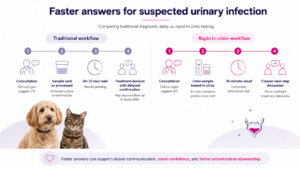
Pet owners are not just questioning the price. They are questioning the process.
Across the UK, conversations about veterinary costs have become more emotionally charged. Pet owners want the best possible care for animals they often see as family, but they also want to understand what they are paying for, why each test or treatment is needed, and whether there are alternatives.
This is not a criticism of veterinary teams. Quite the opposite. Vets are working under intense pressure: clinical complexity, rising operational costs, workforce strain, antimicrobial stewardship responsibilities, and increasingly anxious clients who arrive with high expectations and limited financial flexibility.
The real issue is not simply that veterinary care costs money. It is that uncertainty can make costs feel harder to accept.
When a pet owner receives a bill but does not fully understand the diagnostic reasoning behind it, trust can weaken. When they are told antibiotics may be needed before a clear bacterial answer is available, confidence can become fragile. And when results take 24–72 hours, practices are often forced into a difficult position: act now with incomplete information, or wait while the patient remains uncomfortable.
That is where faster diagnostics could play an important role.
Not by replacing the vet’s clinical judgement, but by making that judgement easier to explain.
The trust gap is now a market issue
In March 2026, the Competition and Markets Authority concluded its investigation into UK veterinary services, stating that a lack of information around ownership, treatment options, and prices was contributing to weak competition and higher prices. Its final reforms include clearer price lists, written estimates for treatments expected to cost £500 or more, better ownership transparency, and a comparison service through RCVS Find a Vet. (GOV.UK)
The CMA was careful to acknowledge the professionalism and compassion of veterinary professionals, noting that the reforms are designed to support trust, transparency, and clinical independence rather than undermine the profession. (GOV.UK)
That distinction matters.
Pet owners are not always looking for the cheapest option. Often, they are looking for clarity. They want to know:

What are we testing for? Why does it matter? What happens if we wait? What happens if we treat now?
The CMA-commissioned pet owner survey highlights this need. Only 46% of pet owners said they were provided price information in advance of their most recent treatment or service, while 34% said they were not provided pricing information at all in advance. The same research found that diagnostic tests had been used by 41% of respondents in the preceding two years, showing how central diagnostics already are to the client experience.
So, the opportunity is not just to make pricing clearer. It is to make clinical decision-making clearer.
Diagnostics can make clinical decisions easier to explain
Veterinary medicine has always relied on trust. But today’s pet owners increasingly expect that trust to be supported by visible evidence.
A rapid in-clinic test can change the tone of a consultation.
Instead of saying:
“Based on the symptoms, we may need to start antibiotics while we wait for culture.”
The conversation can become:
“We can test this urine sample now to see whether a common bacterial pathogen is present. That result can help guide what we do next.”
That shift is powerful. It gives the vet more information. It gives the pet owner a clearer reason for the recommendation. And it can help reduce the perception that treatment is being added without explanation.
In cases such as suspected urinary tract infection, this matters. Urinary tract disease is a common clinical presentation in dogs and cats and a common reason for antimicrobial prescription, according to the ISCAID guidelines for bacterial UTIs in dogs and cats. (ScienceDirect)
But UTI decision-making is rarely simple. Clinical signs, urinalysis, bacteriuria, contamination risk, subclinical bacteriuria, culture, and antimicrobial susceptibility all need to be considered. Rapid diagnostics do not remove that complexity. They help surface useful information earlier.
The problem with waiting days for answers
Culture remains an important diagnostic standard, particularly when antimicrobial susceptibility testing is required. But it often takes 24–72 hours to deliver definitive results. In the meantime, vets may need to make decisions during a short consultation, with an uncomfortable patient in front of them and a concerned owner asking for immediate help.
FluoretiQ’s VERI-5 Vet describes this exact challenge: culture-based methods require 24–72 hours, which can lead clinicians to initiate empirical antimicrobial therapy before results are available. It also notes that practical barriers such as cost, transport, and lack of on-site facilities can limit culture use.
That delay creates friction in three places:
First, it affects clinical confidence. The vet may have to act before the Bacteriuria is identified.
Second, it affects pet-owner confidence. The owner may wonder why they are paying for tests that will not help until days later.
Third, it affects antimicrobial stewardship. Empirical antibiotic use may be necessary in some cases, but it is not ideal when more targeted information could be available sooner.
The British Veterinary Association describes antimicrobial resistance as a shared One Health challenge and supports responsible prescribing across the profession. (British Veterinary Association) RCVS guidance also reinforces that prescribing antibiotics requires clinical assessment, with physical examination required in specified circumstances unless exceptional circumstances apply. (Royal College of Veterinary Surgeons)
In other words, the pressure is clear: vets need to treat appropriately, explain clearly, and protect antibiotics, often within minutes.
Faster diagnostics could help rebuild trust in three ways
1. By making recommendations easier to explain
When a diagnostic result is available during the consultation, the vet can anchor the conversation in evidence.
This does not mean every decision becomes automatic. It means the vet can say, “Here is what we found, here is what it suggests, and here are the next options.”
That is a very different experience from asking a client to accept uncertainty.
2. By helping owners see value in the bill
Pet owners may be more willing to accept diagnostic costs when they understand how the result changes the decision.
A test that gives actionable information during the appointment can feel more connected to the outcome than a delayed result that arrives after treatment has already started.
That perceived connection between test, decision, and care plan is central to trust.
3. By supporting responsible antibiotic conversations
Antibiotic stewardship can be difficult to explain in a busy consult room. Owners may expect antibiotics because they associate them with action. Vets may need to explain why antibiotics are, or are not, appropriate.
Rapid bacterial identification can help make that conversation more concrete.
The message becomes less about withholding treatment and more about choosing the right treatment at the right time.
Where Veri-5 Vet fits into the conversation
FluoretiQ’s VERI-5® system has been developed as a rapid, direct-from-sample point-of-care diagnostic for common veterinary uropathogens. In the evaluation, VERI-5 detected common veterinary uropathogens within 15 minutes using Nanoplex® glycan-coated beads that agglutinate in the presence of target bacteria.
In retrospective testing, the system showed overall sensitivity of 91%, with 90% sensitivity for E. coli and 92% Proteus mirabilis, 90% for Klebsiella pneumoniae, and overall specificity of 92%. It further notes that specificity approached the predefined target and that further probe optimisation could enhance species-level identification and clinical utility.
For veterinary practices, the value is not simply speed for speed’s sake. It is speed that can support a better consultation:
A clearer starting point.
A more informed discussion.
A stronger explanation for treatment decisions.
A more confident antimicrobial stewardship conversation.
FluoretiQ’s wider messaging is built around empowering clinicians and veterinarians to make better decisions faster, with faster results, smarter spending, and protection of antibiotics as core themes.
That is the real trust opportunity.
Faster answers will not solve every pricing concern but they can change the conversation
It would be too simplistic to say rapid diagnostics will “fix” veterinary trust. Pet-owner confidence is shaped by many factors: communication, transparency, continuity of care, practice ownership, estimates, insurance, treatment outcomes, and personal financial pressure.
But diagnostics are one of the most tangible ways to show the reasoning behind a recommendation.
When a client can see that a test supports the decision, the bill becomes less abstract. When a vet can explain what has been ruled in or out, the recommendation feels less like guesswork. When antimicrobial decisions are guided by earlier evidence, stewardship becomes easier to understand.
The future of veterinary trust will not be built on cheaper care alone.
It will be built on clearer care.
And rapid diagnostics may become one of the most practical tools for helping veterinary teams show pet owners not just what treatment costs but why it matters.
Discover how FluoretiQ is developing rapid point-of-care diagnostics to support faster, evidence-based decisions in veterinary practice.
Learn More
FluoretiQ is providing early access to a limited number of practices via their Technology Access Partnership (TAP). Learn more about the TAP here: www.fluoretiq.com/tap/