Veterinary AI is moving fast. The evidence still has to come from somewhere.
Artificial intelligence is rapidly becoming part of everyday veterinary practice.
It can transcribe consultations, summarise clinical histories, organise patient information and help teams communicate more efficiently. In 2025, the British Veterinary Association reported that 21% of vets were already using AI in their daily work, with diagnostic reporting and data interpretation among the most frequently cited applications. (British Veterinary Association)
But that same research revealed the tension at the heart of veterinary AI. Among the risks identified by vets, 83% highlighted results being interpreted without sufficient context, while 82% were concerned about AI being used without appropriate follow-up checks. (British Veterinary Association)
The question is no longer whether AI will enter the consultation room.
It is already there.
The more important question is: what should AI be trusted to do and what still requires real-world diagnostic evidence?
AI can organise information. It cannot create evidence that was never collected.
A well-designed AI tool can process large amounts of information quickly.
It might identify patterns in a patient’s history, highlight a previous treatment or turn a ten-minute conversation into a structured clinical record. These are valuable capabilities, particularly for veterinary teams working under significant time pressure.
But a consultation transcript is not a biological sample.
An AI-generated summary may record that a dog is urinating more frequently, appears uncomfortable or has blood in its urine. It cannot determine which bacterium is present simply by making the notes more organised.
To answer that question, the veterinary team still needs objective information from the patient.
That distinction matters because information and evidence are not the same thing.
AI can help organise what is already known. Diagnostic technology helps uncover what is happening biologically. The veterinary professional then interprets both within the context of the individual patient.

The vet must remain in the loop
The Royal College of Veterinary Surgeons advises that clinical decision-making should not be wholly delegated to an AI tool. Veterinary professionals remain responsible for patient-care decisions and are expected to scrutinise AI outputs, question assumptions and understand the limitations of the technology being used. The RCVS also states that AI-generated clinical records should be manually verified and corrected where necessary. (Royal College of Veterinary Surgeons)
The British Veterinary Association takes a similar position. Its principles for veterinary AI emphasise that AI should support rather than replace the vet, with human oversight, critical validation, transparency, data privacy and explainability built into its use. (British Veterinary Association)
That does not make veterinary AI less exciting.
It makes its role clearer.
The strongest tools will not attempt to remove the veterinary professional from the decision. They will reduce unnecessary friction, reveal useful patterns and give clinicians more time to focus on interpretation, communication and patient care.
A useful model for the technology-enabled consultation
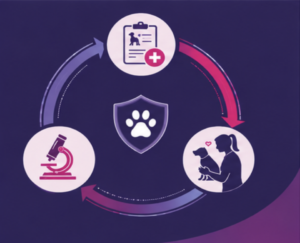
The future consultation room is unlikely to depend on one all-knowing platform. It will bring together different technologies, each performing a clearly defined role.
1. AI organises
AI may help capture the consultation, structure the clinical history, retrieve relevant records and reduce repetitive administrative work.
2. Diagnostics reveal
Diagnostic tools generate information directly from the patient or sample. They help answer biological questions that cannot be resolved from the clinical record alone.
3. The veterinary professional decides
The vet connects the history, clinical examination, diagnostic findings and individual circumstances of the patient. The final decision remains a professional judgement—not a software output.
This separation of roles is important. A tool that writes notes should not quietly be treated as though it has confirmed a diagnosis. Equally, a diagnostic result should not be interpreted without the wider clinical picture.
Good technology makes professional judgement better informed. It does not make professional judgement optional.
Explainability is not only a technical issue
As more technology enters veterinary practice, teams must also be able to explain how it supports the patient journey.
That matters to pet owners.
Research commissioned as part of the UK veterinary-services market investigation found that, when diagnostic tests were discussed, pet owners particularly valued information about potential benefits and consequences, result timescales, risks and price. Trust in the veterinary recommendation was also a major reason owners chose to proceed with testing.
A technology may be sophisticated behind the scenes, but its purpose should still be understandable at the consultation-room level.
The owner should be able to understand:
- what question the tool is helping to answer;
- what information it can and cannot provide;
- how the result may affect the next step;
- why the veterinary professional is recommending it.
This is particularly important when AI contributes to an output. In June 2026, the Veterinary AI Transparency Alliance published a draft framework calling for risk-proportionate scrutiny, clear statements of intended use and limitations, human oversight and transparent information about how veterinary AI tools operate. (Royal College of Veterinary Surgeons)
The principle is straightforward: the greater a tool’s influence on diagnosis or treatment, the greater the need for evidence, transparency and oversight.
Where point-of-care diagnostics fit
This is where the distinction between workflow intelligence and diagnostic evidence becomes especially valuable.
VERI-5® Vet is being developed to identify common canine and feline uropathogens directly from urine in approximately 15 minutes.
The system uses Veri-5® technology: glycan-coated beads designed to bind target bacteria and form agglutination patterns that can be evaluated through proprietary image analysis. The result is intended to contribute an additional piece of objective information to the wider clinical assessment not to replace examination findings, patient history, veterinary judgement or laboratory testing where further investigation is required.
The important point is not that one technology should replace another.
It is that each technology should solve the right problem.
An AI scribe may help ensure the consultation is accurately documented. A point-of-care diagnostic may help reveal what is present in the sample. The veterinary team then decides what those findings mean for the patient.
Together, those tools may create a more connected journey from presentation to evidence to action.
Five questions to ask before adopting a new veterinary technology
Whether a practice is considering an AI scribe, a diagnostic-support platform or a point-of-care test, five questions can help separate useful innovation from unnecessary noise:
- What specific problem does the technology solve?
Faster is only valuable when the output changes something meaningful. - What information is the output based on?
Is it using clinical notes, images, laboratory data or direct biological measurements? - How has the technology been evaluated?
Practices need to understand the intended use, validation, limitations and relevant patient population. - What happens when the result is uncertain or incorrect?
There should be a clear pathway for verification, escalation or further testing. - Who remains responsible for the decision?
Technology may support the pathway, but professional responsibility remains with the veterinary team.
These questions reflect a wider shift in veterinary innovation. New tools will increasingly be judged not only by what they can do at their best, but by how clearly they communicate their boundaries.
The future is not AI versus diagnostics
Artificial intelligence and diagnostic technology should not be positioned as competing visions of veterinary medicine.
They solve different problems.
AI can reduce administrative load, organise complex information and support interpretation. Diagnostics can produce objective evidence from the patient. Veterinary professionals bring clinical context, accountability, empathy and judgement.
The most advanced consultation room will not be the one with the greatest number of algorithms.
It will be the one where each tool has a clear purpose, every output can be questioned and the veterinary team receives useful evidence at the moment it matters.
AI may help write the record. Better diagnostics help inform what happens next.
Discover how FluoretiQ is redesigning point-of-care diagnostics to give veterinary teams faster, actionable information while keeping clinical judgement firmly at the centre of care.
FluoretiQ is providing early access to a limited number of practices via their Technology Access Partnership (TAP). Learn more about the TAP here: www.fluoretiq.com/tap/